
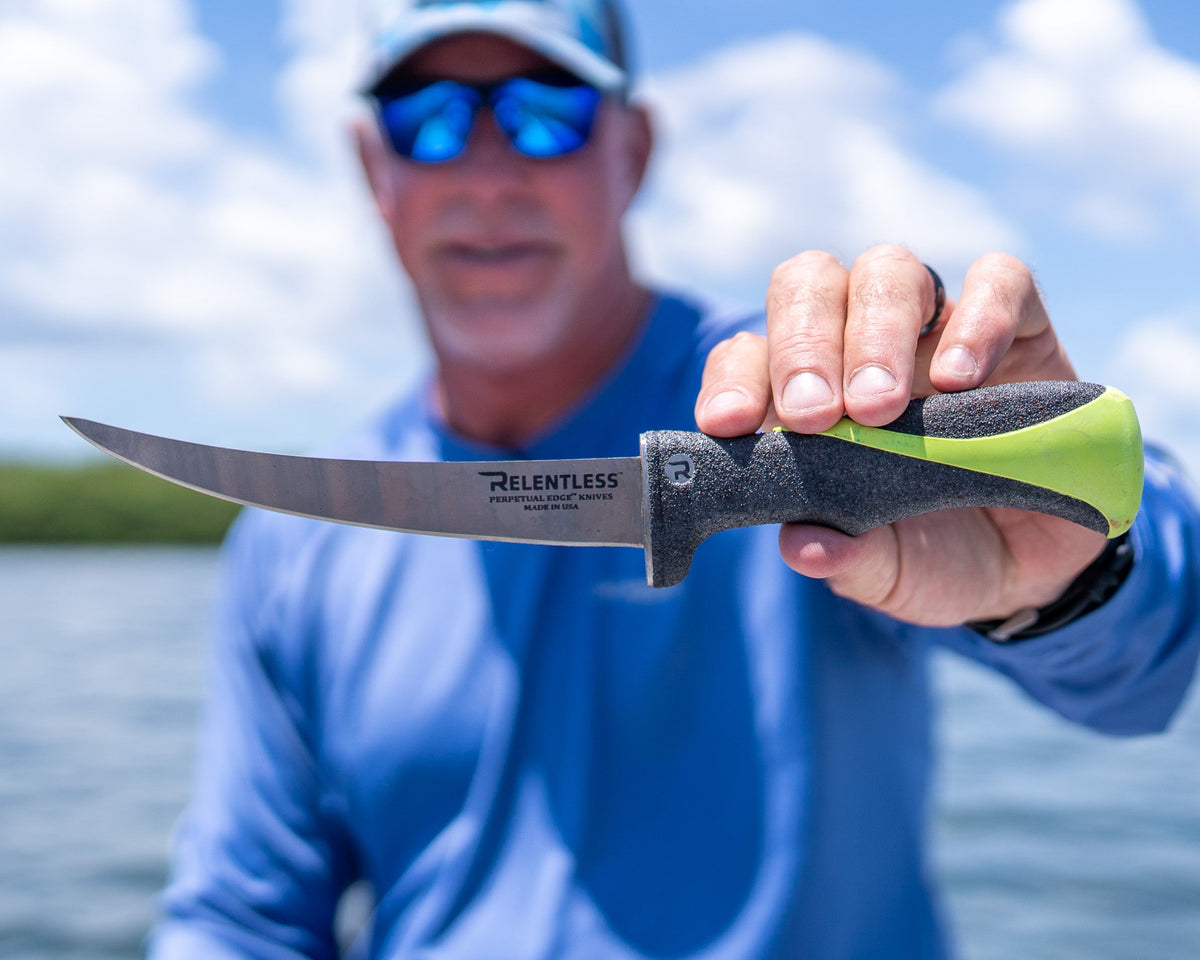
The best fillet knife for salmon needs more reach than the knife you might use for crappie, trout, or walleye. On a larger salmon, a short blade can turn one smooth pass along the backbone into several smaller cuts.
For most anglers targeting bigger salmon, a 9-inch curved fillet knife is a strong starting point. It provides useful reach for broad fillets while remaining manageable around ribs and changing contours. For especially large salmon, a 10-inch straight blade gives you more length for long, controlled passes.
Relentless offers both configurations in lightweight titanium. Its 9-inch curved titanium fillet knife for salmon is the better all-around starting point for most larger salmon.

What Makes the Best Fillet Knife for Salmon?
Salmon size should drive your knife choice.
A blade that feels right on a walleye may feel too short once a large salmon is on the cleaning table. You need enough reach to follow the backbone and work through broad fillets without giving up control around the ribs and skin.
|
Feature |
What to Look For |
|
Blade length |
About 9 inches for most larger salmon |
|
Blade shape |
Curved for versatility, straight for long passes |
|
Flex |
Controlled flex without feeling overly soft |
|
Blade material |
Lightweight and corrosion-resistant |
|
Edge |
Designed to maintain useful cutting performance |
|
Handle |
Secure with wet or slimy hands |
|
Weight |
Comfortable during repeated long cuts |
The goal is not to buy the longest knife available. Choose enough blade for the fish while keeping the control needed for clean work.
What Size Fillet Knife Is Best for Salmon?
For anglers targeting larger salmon, a 9-inch blade is a practical starting point. Smaller and larger blades still have their place.
7 to 8 Inches for Smaller Salmon
A 7- or 8-inch blade can work well on smaller salmon or for anglers who prefer a more compact knife.
The shorter blade may feel easier to maneuver around ribs and detail areas. It can also make sense if you regularly clean smaller species with the same knife.
On larger salmon, however, a shorter blade may require more repositioning during long cuts.
9 Inches for Most Larger Salmon
A 9-inch blade offers more reach along the backbone and across broad fillets without the extra length of a longer profile.
Relentless's fillet-knife sizing guide places salmon in its 9-inch curved category, making it the most natural starting point in the product line.
The curved profile also gives you useful maneuverability when the cut changes direction around ribs and other contours.
10 Inches for Large Salmon and Broad Fillets
A 10-inch blade becomes useful when the fish get especially large.
Think mature Chinook or another salmon with a long backbone and broad fillets. Extra blade length lets you make longer passes with fewer stops to reposition.
The 10-inch straight titanium fillet knife for large salmon is specifically designed for long work around broad fish, including salmon.
If salmon are only part of what you catch, our guide to choosing the right fillet knife size compares blade lengths across more species.
Should a Salmon Fillet Knife Be Flexible or Stiff?
A good salmon fillet knife should flex in a controlled way.
Some flex helps the blade follow the fish's shape. Too much can make a long blade feel less predictable when you cut around a substantial backbone and rib cage.
The goal is enough give to follow contours while keeping the edge under control.
Following the Backbone and Ribs
A large salmon rewards smooth, deliberate cuts.
Extra blade length lets you cover more of the backbone with each pass. As you reach the rib cage, controlled flex helps the blade follow the fish's shape without feeling overly soft.
Skinning a Salmon Fillet
Blade length is also useful when removing skin from a broad fillet.
A longer knife gives you more surface to cut. Flex, edge condition, and technique all affect the result, so don't choose based on length alone.
Curved vs. Straight Fillet Knife for Salmon
Both shapes can work well. The better choice depends on salmon size and how you prefer to cut.
Why a 9-Inch Curved Blade Is a Strong Starting Point
A curved blade works well when the cut direction changes throughout the job.
Its profile suits sweeping passes and remains manageable as you work around ribs and other contours.
For most anglers who want one manual salmon knife, that reach and maneuverability make a 9-inch curved blade a versatile option.
When a 10-Inch Straight Blade Makes More Sense
A straight blade becomes attractive when reach and long cutting paths are the priority.
On a particularly large salmon, a 10-inch blade provides more length to work with across a broad fillet.
Neither shape is universally better. The 9-inch curved knife is the more versatile starting point, while the 10-inch straight knife is a useful alternative for very large fish and anglers who favor long, direct passes.
For more detail, see our curved vs. straight fillet knife guide.
Why Blade Material and Edge Performance Matter on Salmon
A larger fish means more cutting.
If several salmon are waiting at the cleaning station, you will make repeated passes along backbones, around ribs, through skin, and across broad fillets. Weight and edge performance become more noticeable as the work adds up.
Relentless uses aerospace-grade titanium to keep its longer fillet knives lightweight while providing strong corrosion resistance.
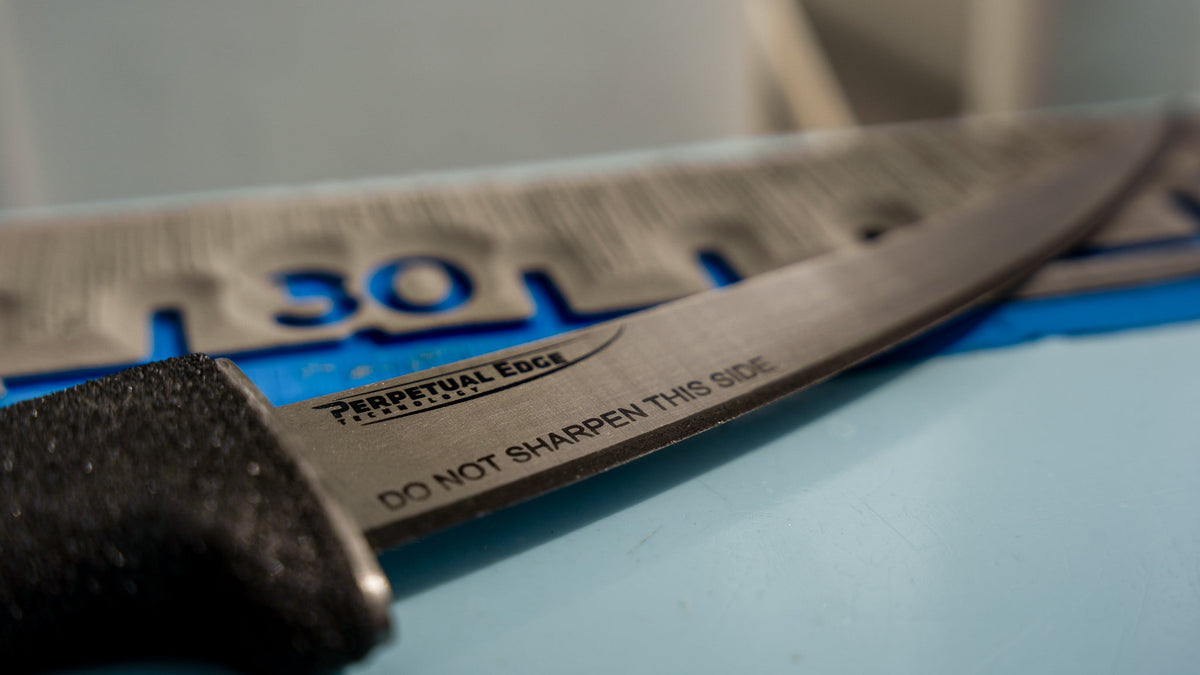
The brand also uses Perpetual Edge Technology to control how the cutting edge wears.
Its Power Strip uses carbide and crushed diamond technology to create different wear characteristics along the edge. The system is engineered to help maintain a useful cutting profile as the knife is used.
That doesn't make the knife maintenance-free or immune to damage. It is an edge system designed to help keep cutting while retaining the low weight and corrosion resistance that make titanium useful around fish and water.
Best Relentless Fillet Knives for Salmon
Two Relentless configurations make the most sense for anglers targeting larger salmon.
Best All-Around: 9-Inch Curved Titanium Fillet Knife
The 9-inch curved titanium fillet knife is the better all-around starting point.
Its actual blade length is 8.8 inches, and the knife weighs 5.5 ounces. It uses 6AL-4V titanium and a curved asymmetrical edge.
That gives you useful reach for a larger fish without adding unnecessary weight.
Relentless also pairs the blade with Perpetual Edge Technology, a SlickCut anti-friction treatment, and a True Grit handle designed for wet, slimy conditions.
Best for Very Large Salmon: 10-Inch Straight Titanium Fillet Knife
For especially large salmon, consider the 10-inch straight titanium fillet knife.
Relentless specifically positions this model for long, clean passes around broad fish such as salmon and halibut. The knife weighs 5.5 ounces and uses 6AL-4V titanium.
For most salmon, start with the 9-inch curved knife. Move to the 10-inch straight option when fish size or your cutting style calls for the extra reach.

Manual vs. Electric Fillet Knife for Salmon
An electric fillet knife can make sense when the main goal is to process a large volume of fish quickly.
A manual knife offers a different set of advantages.
No batteries to charge, cords to manage, or motors to bring to camp. You also have direct control as you follow the backbone, work around ribs, and remove skin.
For an angler who wants one premium knife for salmon and values control and simplicity, a manual fillet knife is a strong fit.
Grip and Control Matter on a Large, Slippery Fish
A salmon does not stay clean and dry once filleting starts.
The table gets wet. Your hands pick up water and slime. The fish becomes harder to hold as you work through it.
A longer blade gives you reach, but that reach is only useful when you can control the knife.
Relentless uses its True Grit glass-reinforced handle on both salmon-sized models. The handle is designed to provide grip when hands are wet or slimy.
How to Care for a Salmon Fillet Knife
Even a corrosion-resistant titanium knife needs proper care.
After cleaning fish, wash a Relentless knife with fresh water and liquid dish soap. Rinse it with clean fresh water and dry it before storage.
Avoid abrasive or chemical cleaners, and do not put the knife in a dishwasher.
Perpetual Edge knives also require different edge-maintenance practices than a conventional steel blade. Follow Relentless's maintenance instructions instead of treating the Power Strip like a standard bevel.
Relentless provides factory edge maintenance and other services through the Relentless Lifetime Maintenance Warranty, subject to its published terms and limitations.
Best Fillet Knife for Salmon FAQs
What Size Fillet Knife Is Best for Salmon?
For most anglers targeting larger salmon, a 9-inch fillet knife is a strong starting point.
A 7- or 8-inch blade works well for smaller salmon. For especially large fish, a 10-inch blade provides additional reach.
Is a 9-Inch Fillet Knife Good for Salmon?
Yes.
A 9-inch blade offers a useful balance of reach and control for larger salmon. A curved profile adds maneuverability when working around changing contours.
Should a Salmon Fillet Knife Be Flexible?
Some controlled flexibility is useful.
The blade should follow the fish's shape without feeling hard to control during longer cuts.
Is a Curved or Straight Fillet Knife Better for Salmon?
For most anglers, a curved blade is the more versatile starting point.
A longer straight blade becomes useful for particularly large salmon and anglers who prefer long, direct passes through broad fillets.
Is a Manual or Electric Fillet Knife Better for Salmon?
It depends on how many fish you process and how you prefer to work.
Manual knives provide direct control and require no power source. Electric knives can be useful when you're processing larger quantities and speed is your top priority.
Which Relentless Fillet Knife Should You Choose for Salmon?
For most anglers targeting larger salmon, start with the 9-inch curved fillet knife.
It provides the reach needed for a bigger fish while remaining manageable around ribs, contours, and skin.
If you regularly clean especially large salmon or prefer long, direct passes through broad fillets, the 10-inch straight model is the better alternative.
Both combine lightweight titanium construction with corrosion resistance, Perpetual Edge Technology, True Grit handles, USA manufacturing, and long-term factory maintenance support.
At the time of this review, both models are listed as sold out. Until inventory returns, check the Relentless 9-inch curved titanium fillet knife for current availability.


Leave a comment
This site is protected by hCaptcha and the hCaptcha Privacy Policy and Terms of Service apply.