
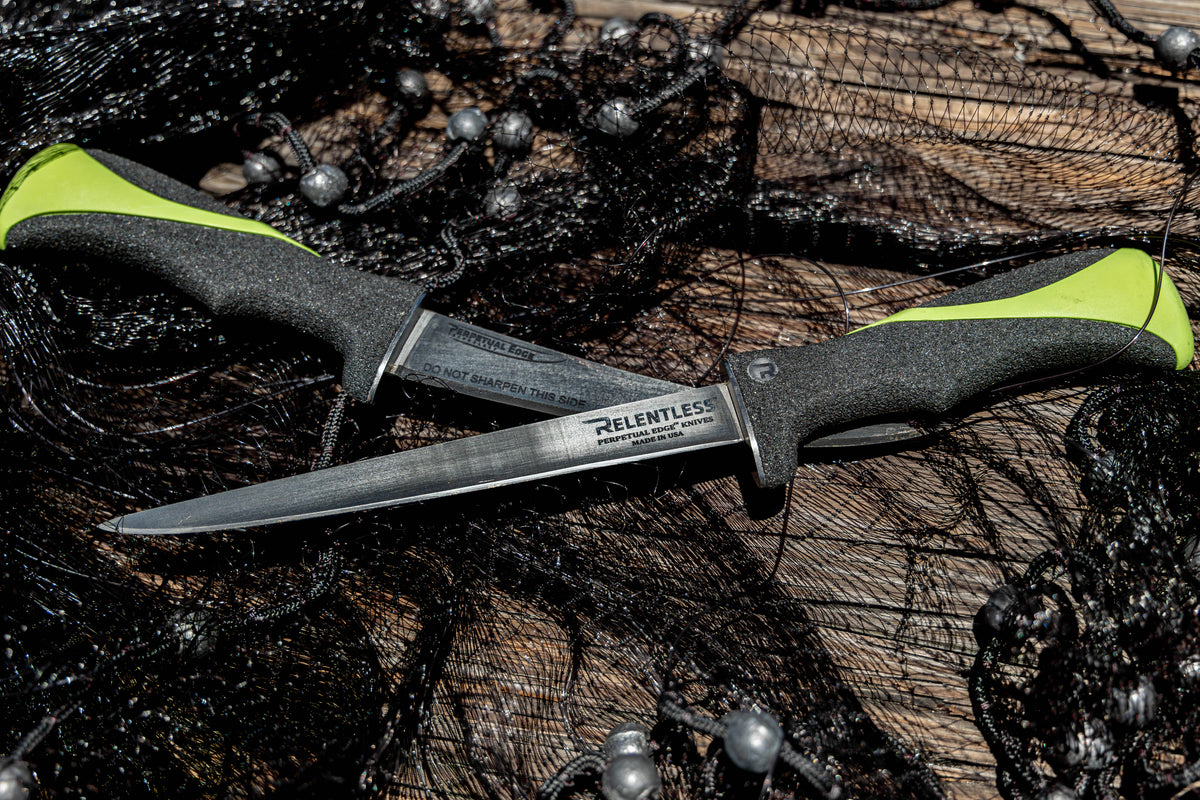
Choosing between a curved and a straight fillet knife depends on the fish you clean and the cuts you make most often.
For anglers cleaning snapper, redfish, sheepshead, and similar mid-sized saltwater fish, a 7-inch curved blade is usually the more versatile starting point. Its profile works well for sweeping cuts and gives you useful maneuverability as you work around the fish's shape.
Straight blades have advantages too. They can be useful for controlled cuts around certain bone structures and for longer passes through broad fillets.
For a practical example of the curved style, Relentless offers a 7-inch curved fillet knife for coastal fish designed for wet, demanding fishing conditions.

Curved vs. Straight Fillet Knife: Quick Comparison
Both blade styles can work well. The better choice depends on fish size, body shape, blade length, flex, and your cutting technique.
|
Feature |
Curved fillet knife |
Straight fillet knife |
|
Blade shape |
Sweeping curve toward the tip |
Straighter cutting profile |
|
Common advantage |
Sweeping cuts and maneuverability |
Controlled cutting paths and straight passes |
|
Typical applications |
General filleting, working around ribs, skinning |
Precision trimming, selected bone structures, broad fillets |
|
Mid-sized saltwater fish |
Strong all-around choice |
Useful for specific tasks and species |
|
Larger fish |
Longer curved blades can work well |
Longer straight blades can be useful |
|
Best starting point for most coastal anglers |
Yes |
Depends on species and technique |
Blade shape is only part of the decision. Length and flexibility matter just as much.
A 7-inch curved knife may fit snapper better than a 10-inch straight knife, but that doesn't mean curved blades are always better. The fish in front of you should drive the choice.
What Is a Curved Fillet Knife Best For?
A curved fillet knife works well when you want a sweeping cutting motion and good maneuverability around changing contours.
That makes it a practical choice for many common saltwater species, especially when working along the backbone, around ribs, or through areas where the fish's shape changes.
Following Ribs and Fish Contours
Picture cleaning a redfish or snapper at the dock.
As you guide the knife along the frame, a curved profile can make sweeping movements feel natural as you work around the fish's body. Blade flex, length, and technique still play major roles in how closely you can follow ribs and bones.
The goal is not speed alone. Control matters more, especially when working near bone or trying to keep the fillet intact.
Sweeping Cuts and Skin Removal
Curved blades also work well for longer sweeping motions.
This can help when separating a fillet from the frame or removing skin in a controlled pass. A curved knife isn't automatically better for every skinning job, since blade length, flex, and technique also affect the result.
For mid-sized coastal fish, a 7-inch curved fillet knife offers a practical balance of reach and maneuverability.

What Is a Straight Fillet Knife Best For?
Straight fillet knives are not simply less curved versions of the same tool.
Their profile works well when the job calls for a direct cutting path, precise trimming, or longer passes through broad fillets.
Precision Cuts Around Bones
Some fish have heavier or more complex bone structures than others.
Grouper is a good example. Working around the spine, gill area, and thicker bone structure can benefit from a knife designed for controlled, precise work.
Relentless offers an 8-inch straight fillet knife specifically for grouper and bottom fish.
That does not mean every straight blade is stiff or every curved blade is flexible. Shape and flex are separate characteristics.
Long Cuts Through Larger Fillets
Longer straight blades can also be useful on broad fish.
For example, when cleaning salmon or halibut, extra blade length can help you make smooth passes through wide fillets with fewer stops to reposition.
The 10-inch straight fillet knife for larger fish is designed for that work.
Which Fillet Knife Shape is Best for Different Fish?
Different fish call for different approaches.
Use this as a starting point rather than a strict rule.
|
Fish |
Recommended starting point |
Why |
|
Snapper |
7" curved |
Versatile control and sweeping cuts |
|
Redfish |
7" curved |
Good balance of reach and maneuverability |
|
Sheepshead |
7" curved |
Useful control around the fish's structure |
|
Grouper |
8" straight |
Precise work around heavier bone structure |
|
Salmon |
Longer curved or straight |
Choice depends on fillet width and technique |
|
Halibut |
10" straight |
Long cutting path for broad fillets |
An experienced angler can use either blade shape successfully on many of these fish.
The point is not to create rigid rules. Match the blade to the fish, the cut, and the level of control you want.
Blade Shape Isn't Everything: Length and Flex Matter Too
One common mistake is treating blade shape, blade length, and flexibility as the same thing.
They are not.
Blade shape affects the cutting profile. Blade length affects reach and maneuverability. Flex affects how readily the blade follows changes in the fish's shape.
A curved blade isn't automatically more flexible, and a straight blade isn't automatically stiffer.
For most mid-sized saltwater fish, a manageable blade length with controlled flex is more useful than simply choosing the most curved or longest knife available.
For a deeper breakdown of blade lengths, see our guide on choosing the right fillet knife size.
Recommended Relentless Fillet Knives for Saltwater Anglers
The best blade shape depends on what you catch most often.
Best Starting Point: 7" Curved Fillet Knife
For anglers primarily cleaning snapper, redfish, sheepshead, and similar coastal fish, a 7-inch curved knife is a versatile place to start.
It provides useful reach while remaining manageable around ribs and tighter areas.
The 7-inch curved fillet knife for coastal fish is the best fit for everyday saltwater use.
For Grouper and Precise Bone Work: 8" Straight
If grouper or other bottom fish make up a large part of your catch, a straight blade may make more sense.
The 8-inch straight fillet knife for grouper and bottom fish is designed for precise work around spines, gills, and complex bone structures.
When Both Shapes Make Sense
Some anglers regularly clean species with very different body shapes.
In that case, owning both styles can be useful. A curved blade handles general filleting and sweeping cuts, while a straight blade handles precision work or broader fillets.
The Relentless Inshore Set combines curved and straight fillet knives for anglers who want that flexibility.
What Else Matters for Saltwater Fillet Knives?
Blade shape matters, but saltwater anglers also need to think about material, grip, and edge maintenance.
Corrosion Resistance
Saltwater is hard on gear.
A fillet knife may spend time around salt spray, wet cleaning tables, fish blood, and damp storage. That makes corrosion resistance an important consideration.
Relentless uses aerospace-grade titanium, which resists rust and corrosion while keeping the blade light.
Wet-Hand Grip and Edge Maintenance
Grip matters when your hands are wet or covered in fish slime.
Relentless uses a True Grit textured handle designed for wet and slippery conditions. Its knives also use Perpetual Edge Technology, engineered to help maintain the cutting edge as you use the knife.
The Power Strip incorporates carbide and crushed-diamond technology, while SlickCut treatment is designed to reduce friction during cutting.
Relentless knives still require proper care, and edge maintenance may eventually be needed depending on use or damage. Learn more about Relentless titanium and Perpetual Edge Technology, and review the company's knife care and maintenance guidance.

Curved vs. Straight Fillet Knife FAQs
Is a Curved or Straight Fillet Knife Better for Beginners?
For many anglers, a curved fillet knife in a manageable length is a practical place to start.
A 7-inch curved blade works well for a wide range of common fish and offers useful maneuverability around contours and ribs.
Comfort and technique still matter, so choose a knife that feels manageable rather than simply buying the longest blade available.
Is a Curved Fillet Knife Better for Skinning Fish?
Curved blades can work well for skinning because their profile supports sweeping cuts.
Straight blades can also remove skin effectively.
Blade length, flex, edge condition, and technique all affect the result, so blade shape alone does not determine skinning performance.
Are Straight Fillet Knives Better for Large Fish?
Not necessarily.
Long straight blades can help with broad fillets and long passes, but longer curved blades also work well for many larger fish.
Choose based on the fish's body shape and the cuts you prefer.
Do You Need Both Curved and Straight Fillet Knives?
Most recreational anglers can start with one well-matched knife.
If you mainly clean mid-sized coastal species, a 7-inch curved knife may handle most of your work.
Owning both becomes more useful when you regularly clean fish with very different body shapes or want different cutting profiles for different parts of the job.
Which Fillet Knife Should You Choose?
When comparing a curved vs. straight fillet knife, neither design is better for every fish.
For most anglers cleaning mid-sized saltwater species, a 7-inch curved blade is a sensible first choice. It offers a useful combination of reach, control, and maneuverability.
A straight blade becomes more attractive when you regularly clean grouper, prefer a direct cutting path, or work with broad fillets that benefit from longer passes.
If a curved blade fits your style, shop the Relentless 7-inch curved fillet knife for coastal fishing, a USA-made titanium option built for wet, demanding saltwater conditions.

Leave a comment
This site is protected by hCaptcha and the hCaptcha Privacy Policy and Terms of Service apply.