
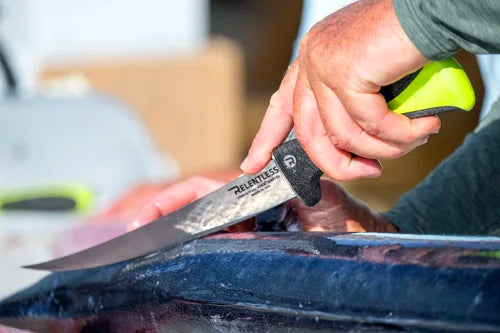
When comparing a titanium vs. stainless steel knife, the better choice depends on where and how you use it. For saltwater anglers, that means looking beyond sharpness to corrosion resistance, weight, cutting performance, and maintenance.
Picture returning to the dock after a day catching snapper or redfish. Your fillet knife has been around salt spray, wet gear, fish slime, and humid air. Now you need a blade that feels comfortable and gives you control as you work through your catch.
Titanium has meaningful advantages in these conditions. It is lightweight, highly corrosion-resistant, and well suited to marine environments.
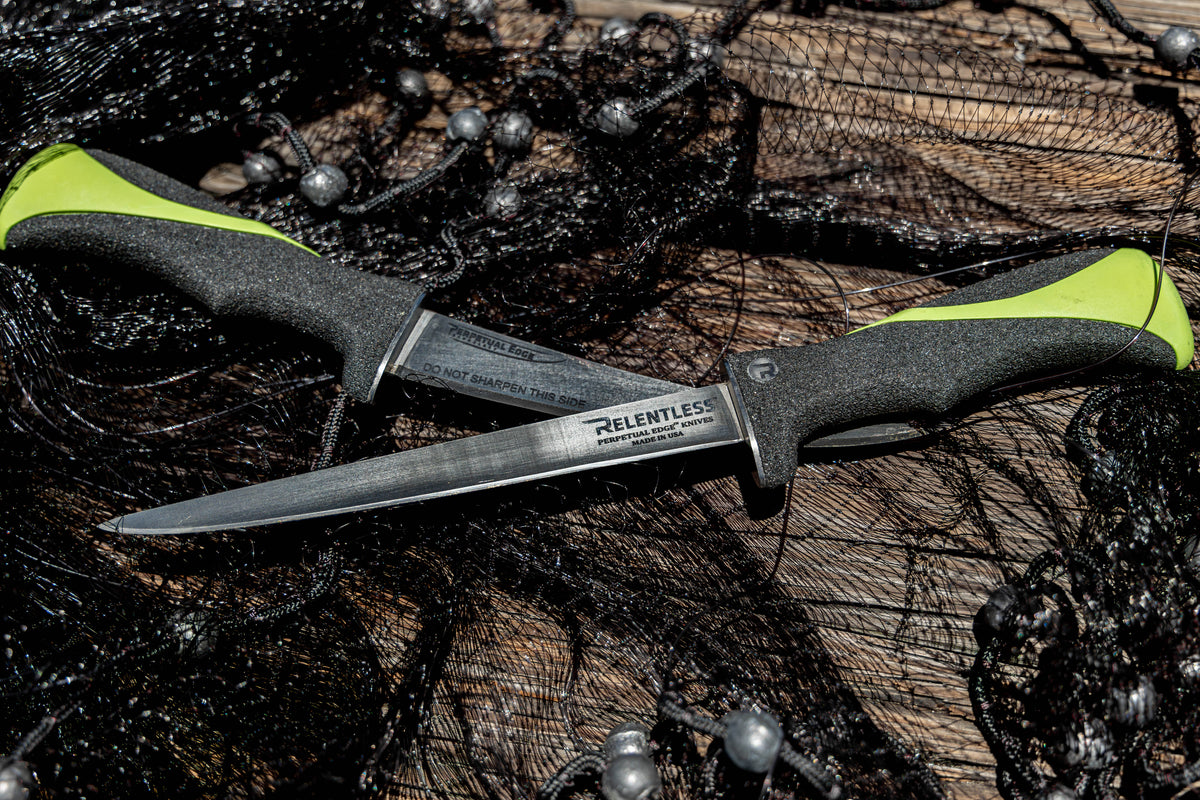
Relentless builds on those benefits with Perpetual Edge Technology, designed to help maintain a sharp edge as the knife is used. Its 7-inch curved titanium fillet knife is one example of a manual knife designed around the needs of saltwater anglers.
Titanium vs. Stainless Steel Knife: Quick Comparison
Both titanium and stainless steel can make effective fillet knives. However, their material properties create different advantages.
|
Feature |
Titanium |
Stainless steel |
|
Saltwater corrosion resistance |
Excellent |
Varies by steel grade |
|
Weight |
Lower density than steel |
Higher density than titanium |
|
Marine environments |
Particularly well suited to saltwater exposure |
Performs well with suitable steel and proper care |
|
Conventional edge retention |
Depends on edge construction |
Often strong with hardened knife steels |
|
Long cleaning sessions |
Lower blade weight can improve comfort |
Depends on knife weight and balance |
|
Maintenance |
Requires cleaning and appropriate edge care |
Requires cleaning, drying, and sharpening |
|
Cutting performance |
Depends on blade and edge design |
Depends on steel grade, heat treatment, and edge design |
The main takeaway is simple.
For anglers who regularly fish saltwater, titanium offers two key advantages: corrosion resistance and low weight.
Those benefits matter every time a knife is exposed to salt spray, handled with wet hands, or used through a long cleaning session.
However, the material alone does not determine how well a knife cuts. Blade shape, flexibility, edge construction, and handle design also play important roles.
Why Titanium Has an Advantage Around Saltwater
Saltwater creates demanding conditions for fishing equipment.
Even a knife that performs well in a dry kitchen may face different challenges on a boat or at a coastal cleaning station.
Corrosion Resistance Matters More on the Water
Titanium naturally forms a thin protective oxide layer on its surface. This layer helps protect the metal against corrosion.
That makes titanium particularly useful around saltwater.
A fillet knife may spend the day exposed to salt spray, fish blood, wet cutting tables, damp tackle bags, and humid coastal air.
These conditions make corrosion resistance more than a convenience.
A corrosion-resistant blade reduces concerns about rust developing during normal exposure to marine environments.
For anglers who regularly clean fish at the dock or keep equipment on a boat, titanium is a strong material choice.
Stainless Steel Is Resistant, Not Immune
Stainless steel also resists corrosion, but its performance depends on the specific alloy.
Some stainless steels are designed for demanding marine environments. Others require more attention when exposed to saltwater.
Salt deposits, prolonged moisture, and improper storage can contribute to corrosion on susceptible stainless steel blades.
Titanium offers excellent corrosion resistance as a fundamental material characteristic.
That does not mean a titanium knife should be left dirty or stored wet. Proper cleaning still matters.
Titanium is particularly well suited to the wet, salty conditions anglers regularly encounter.
Titanium Is Lighter, and That Matters During Fish Cleaning
Titanium has significantly lower density than steel.
When comparing blades of similar size and construction, titanium can reduce weight without requiring a shorter blade.
That difference can matter during repetitive work.
Imagine cleaning several snapper after a long day on the water.
You make repeated cuts along the backbone, follow ribs, remove skin, and trim around bones.
Each fish requires controlled hand and wrist movements.
A lightweight knife can feel easier to manage during these longer cleaning sessions and may help reduce hand and wrist fatigue.
Weight is not the only consideration, though.
Handle shape, balance, and blade length also affect comfort. A well-designed knife should feel controlled in your hand, especially when working through several fish.
For saltwater anglers, titanium lets knife makers combine useful blade length with lower weight.
What About Sharpness and Edge Retention?
Sharpness is one of the most important considerations when choosing a fillet knife.
A good edge helps you work around ribs, separate fillets, and remove skin with control.
When comparing titanium and stainless steel, it is important to understand the difference between blade material and cutting-edge design.
Why Stainless Steel Has Traditionally Been Popular for Knife Edges
Many hardened stainless steels can take and maintain an effective cutting edge.
That is one reason stainless steel has been widely used for fishing knives.
Conventional titanium is generally softer than hardened knife steel, which can affect how a traditional titanium cutting edge wears.
This does not make titanium unsuitable for fillet knives.
It means that edge construction deserves attention when comparing the two materials.
Why a Titanium Knife Needs the Right Edge Design
A knife's cutting performance depends on more than the metal used to make the blade.
Edge geometry, hardness, manufacturing, and wear characteristics all influence how the edge performs over time.
A conventional titanium blade does not automatically hold its edge longer than a hardened stainless steel blade.
However, specialized edge construction can change how a titanium knife wears during use.
This is where Relentless takes a different approach.
How Relentless Addresses the Edge Question
Relentless uses Perpetual Edge Technology to control how the cutting edge wears.
Its Power Strip incorporates tungsten carbide, crushed diamonds, and proprietary materials applied along one side of the titanium blade edge.
This creates a hardness difference between the two sides.
As the knife cuts, the softer titanium side is designed to wear differently from the harder Power Strip side. The goal is to help maintain a useful cutting edge through continued use.
Rather than relying only on making the blade harder, Relentless engineers the edge to sharpen as it cuts.
That is an important distinction from a conventional titanium knife.
This doesn't mean the knife can never be damaged or will never need maintenance. Relentless provides specific edge-care instructions and factory maintenance support.
Learn more about Perpetual Edge Technology and titanium construction or read the story behind Relentless's Perpetual Edge Technology.

Titanium vs. Stainless Steel for Maintenance
Both materials require proper care.
The difference is that titanium's corrosion resistance can reduce one of the main concerns associated with saltwater exposure.
Saltwater Care for Stainless Steel
Clean stainless steel fillet knives after use, especially after saltwater exposure.
Remove salt deposits and fish residue, and dry the blade before storage.
Conventional stainless steel edges also require periodic sharpening.
How often depends on the steel, cutting technique, the fish being cleaned, and how often you use the knife.
Caring for a Titanium Fillet Knife
Titanium's corrosion resistance doesn't mean it's maintenance-free.
Relentless recommends cleaning its knives with fresh water and liquid dish soap, then rinsing with fresh water.
The company advises against abrasive cleaners, chemical cleaning agents, and using the dishwasher.
Owners should also dry the knife before storage.
Relentless's Perpetual Edge Technology requires a different approach to edge maintenance than a conventional steel blade.
Owners should follow the company's instructions and avoid sharpening the Power Strip side.
For specific guidance, review Relentless knife sharpening and maintenance guidance.

Why Titanium Makes Sense for a Saltwater Fillet Knife
When you consider the conditions saltwater anglers face, titanium's advantages become easier to see.
Corrosion Resistance
A knife used around salt spray, fish blood, and wet gear benefits from a blade material that strongly resists corrosion.
Titanium is particularly well suited to those conditions.
Low Weight
Filleting several fish involves repeated cuts and constant blade control.
Titanium's lower density can help reduce blade weight, making the knife easier to manage during longer cleaning sessions.
Specialized Edge Technology
Relentless combines titanium with Perpetual Edge Technology to address how a conventional cutting edge wears down.
The design is engineered to help maintain cutting performance as the knife is used.
Built Around the Fishing Environment
Blade material is only one part of a good fillet knife.
Relentless also uses its True Grit handle, designed to provide grip when hands are wet or slimy.
Its SlickCut treatment reduces friction during cutting.
These features matter when you are cleaning fish at a wet dock or working through several fillets after a long day on the water.
Titanium alone does not make a great fillet knife. The advantage comes from combining the material with the right blade shape, edge system, grip, and overall design.
Recommended Titanium Fillet Knife for Mid-Sized Saltwater Fish
For anglers primarily cleaning snapper, redfish, sheepshead, and similar coastal species, a 7-inch curved blade is a practical all-around choice.
Relentless 7-Inch Curved Titanium Fillet Knife
The 7-inch curved titanium fillet knife offers a useful balance of reach and maneuverability.
Its curved blade works well for sweeping cuts and following the contours of mid-sized fish.
Aerospace-grade titanium construction resists rust and corrosion while keeping blade weight low.
Relentless pairs that blade with Perpetual Edge Technology, a True Grit handle designed for wet conditions, and SlickCut treatment to help reduce friction.
Made in the USA, this knife is designed for anglers who want a manual fillet knife built for demanding saltwater conditions.
If you are still deciding which blade length best matches your catch, see our guide on choosing the right fillet knife size.

What Does Stainless Steel Still Do Well?
Stainless steel remains a proven material for fillet knives.
Quality stainless steel blades can provide excellent conventional cutting performance, and some alloys offer strong corrosion resistance in marine environments.
Anglers have used them for decades, and they can perform very well when properly maintained.
The question is not whether stainless steel can make a good fillet knife. It can.
The more useful question is which material better matches your fishing conditions.
For anglers who regularly clean fish around saltwater, titanium's combination of low weight and corrosion resistance makes a compelling case.
Relentless builds on those material advantages with specialized edge technology and long-term maintenance support.
Its Lifetime Maintenance Warranty includes factory service for blade edges and certain other components, subject to the published terms.
Anglers can also review feedback from professional anglers and captains who use Relentless knives.
Titanium vs. Stainless Steel Knife FAQs
Is Titanium Better Than Stainless Steel for Saltwater?
Titanium has meaningful advantages in corrosion resistance and weight.
These characteristics make it particularly well suited to saltwater fishing.
However, overall knife performance still depends on edge construction, blade shape, grip, and manufacturing quality.
Do Titanium Knives Stay Sharp?
Conventional titanium cutting edges don't automatically retain sharpness longer than hardened stainless steel.
Relentless addresses this with Perpetual Edge Technology, engineered to help maintain the cutting edge as you use the knife.
Do Titanium Knives Rust?
Titanium resists rust and corrosion because it forms a protective oxide layer.
That makes it a strong material for marine environments.
Proper cleaning is still recommended after use in saltwater.
Are Titanium Knives Lighter Than Stainless Steel?
Titanium has lower density than stainless steel.
A titanium blade can therefore be lighter than a comparable steel blade.
The finished knife's weight also depends on blade dimensions, handle materials, and overall construction.
Do Titanium Knives Need Sharpening?
They may.
Maintenance depends on the blade's construction and edge design.
Relentless knives are engineered to help maintain their edge during use, but you may still need to maintain the edge over time.
Owners should follow Relentless's published instructions or use its factory maintenance service.
Which Fillet Knife Material Is Better for Saltwater Anglers?
Stainless steel remains an effective knife material, especially when conventional edge performance is the main priority.
But for anglers who regularly fish saltwater, titanium offers a hard-to-ignore combination: excellent corrosion resistance, low weight, and strong suitability for wet marine environments.
Relentless builds on those advantages with Perpetual Edge Technology, giving anglers a specialized cutting-edge system rather than relying on a conventional titanium edge alone.
For anglers cleaning snapper, redfish, and other mid-sized coastal fish, that combination makes titanium worth serious consideration.
If titanium fits your style, shop the Relentless 7-inch curved titanium fillet knife, a USA-made manual knife designed for the conditions saltwater anglers actually face.

Leave a comment
This site is protected by hCaptcha and the hCaptcha Privacy Policy and Terms of Service apply.